
Arrive anywhere. Leave nothing exposed.
Bro ArmorProtection that travels with you.
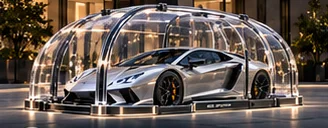
You park. It rises. In under a minute your car is sealed inside a crystal-clear shell that never once touches the paint — then folds back into the bodywork before you pull away.
From US$9,995 · or US$349/month · U1 Sport · In engineering development
Pull up. Press deploy. Walk away.
Fifty-two seconds, start to sealed.
Drawn from the engineering sequence — the same arch count, the same clearance, the same order of operations described in the specification. Production target is 35–60 seconds.
Automated deployment
Five stages. Nothing touches the car.
Park, press deploy, and six telescoping arches rise out of the modules already on the vehicle. Narrow transparent segments travel out along them. The shell closes around the car at a distance.
Drawn from the engineering sequence, not from the marketing renders. Production target 35–60 seconds; first prototype is allowed 90.
Why it exists
A cover hides the car. A garage stays home.
A fitted cover solves the weather and creates two new problems: it lies on the paint, and it turns a car people should see into a shape under a sheet.
A garage solves everything, and then you drive somewhere.
BRO ARMOR is the third option. The hardware lives on the vehicle, so the protection is wherever the car is — a hotel forecourt, a restaurant valet, a hotel in another country. The enclosure is transparent, so the car stays on display while it is protected.
Protection
What it is actually for.
Ranked by what happens to parked cars, not by what sounds impressive.
Keys, rings and careless hands
Whatever is about to touch your car meets a hard-coated surface held a hand-span away from it instead.
Leaning, sitting, climbing
The shell takes the load and has somewhere to go. The clearance gap is what makes that possible.
Thrown objects and road debris
Impact-resistant segments, and any single one can be replaced on its own rather than the whole surface.
Rain, snow and meltwater
Overlapping joints, cold-rated seals, a perimeter gutter and four drains. Water leaves the way it was designed to.
Dust, pollen and birds
Filtered intake and slight positive pressure keep the air around your car cleaner than the air on the street.
Sun
A UV and IR rejecting coating with moving air behind it — not a fabric sheet lying hot against your paint.
Wind
The anchor came with the car.
A deployed shell is eleven square metres of sail. Every freestanding canopy solves that with pegs, ballast or guy lines. BRO ARMOR does not need any of them, because it is bolted to something that already weighs a tonne and a half.
| <b>Wind</b> | Side load Tip margin Slide, wet |
|---|---|
| 50 km/h | 126 kgf · 8.9× · 5.4× |
| 70 km/h | 247 kgf · 4.5× · 2.7× |
| 90 km/h | 409 kgf · 2.7× · 1.7× |
| 100 km/h | 505 kgf · 2.2× · 1.3× |
| 120 km/h | 727 kgf · 1.5× · 0.9× |
Calculated for a 1,500 kg vehicle — the lightest car the U1 platform accepts. A heavier car only improves every number. These are engineering figures, not a certified wind rating; see claims and testing.
Deploy inhibit at 65 km/h
Well inside the margins, not at the edge of them. If the wind is above it, the system simply will not raise.
Automatic retraction at 90 km/h
If wind builds while you are away, it puts itself down and tells you it did. The safest configuration in a gale is retracted.
The load path, in order
Shell → arch → cassette → fit-kit bracket → the vehicle’s own structural mounting points. Six brackets share it. At the inhibit threshold each one sees about 0.67 kN of shear.
The car is not the limit
At 90 km/h the car has 2.7× margin against tipping and 1.7× against sliding on a wet surface. The binding constraint is the arch root, which is where the engineering effort belongs.
Power
It runs for days. On a sunny day it runs for free.
The obvious worry about a system that ventilates, watches and stays connected while you are away is the battery. Here is the whole budget, and the reason it balances.
| Climate blowers | 192 Wh |
|---|---|
| Perimeter radar | 29 Wh |
| Control and locks | 34 Wh |
| Connectivity | 5 Wh |
| Cameras | 4 Wh |
| Deploy and retract, twice | 18 Wh |
| <b>Total standby</b> | 283 Wh per day |
| <b>With no charge at all</b> | 3.4 days |
The blowers are 79% of it
Which is the whole design insight: the load that dominates the budget is the one that only appears when the sun is out.
The top of the system faces the sky
Thin-film PV laminated into the cassette top faces and the arch crowns. 1.24 m² deployed, and 0.68 m² still generating when the system is fully retracted and the car is simply parked.
Energy-positive on a clear day
Roughly 927 Wh generated against 283 Wh consumed — about 3.3× the demand. Even retracted, the cassette tops alone make 513 Wh, which is 1.8× what the system needs.
Overcast still carries most of it
About 222 Wh on a dull day — 79% of demand — so the pack drains slowly rather than suddenly.
Climate
A managed microclimate, not a sealed box.
A transparent enclosure in direct sun is a greenhouse unless air is moving through it. Air is moving through it.

Filtered intake, low in the rails
Air enters through replaceable filters at the lowest point of the side cassettes, where it is coolest and cleanest.
The gap is the duct
That 150–250 mm of clearance is not empty space. It is the channel the air travels along the whole length of the car.
Exhaust at the crown
Warm air leaves through protected vents at the top, which is where it was trying to go anyway.
Sensors set the pace
Roof, front, rear and ambient temperature plus humidity decide fan speed, continuously, all day.
Security
The perimeter works whether or not the shell is up.
The sensors live in the modules. WATCH mode runs every day with nothing deployed; SHIELD and LOCKDOWN add the enclosure on top of it.
WATCH — Always aware
An invisible boundary, held around the car every day.
SHIELD — Instant protection
One command, and the weather stops being your problem.
LOCKDOWN — Maximum security
Sealed, locked, recorded, and talking to your phone.
CLIMATE — Managed conditions
Filtered air, moving, the whole time you are away.
Four 60 GHz nodes establish PREWARN, TRACK, TAMPER and BREACH boundaries around the vehicle.
Universal platform
One mechanism. Three envelopes. A fit kit per car.
The expensive engineering is universal within a platform. Moving to a different vehicle means a new fit kit, not a new system.

Concept photography
Deployment sequence.
Concept renders of the same sequence. The drawings above are the engineering reference; these are the intent.




Ownership
Buy it, lease it, or station it.
The hardware is transferable by design, which means it does not have to be bought outright to be worth having.
From US$9,995
Installed by an approved partner
You own the system. When you change cars, it comes with you — a new fit kit is the only vehicle-specific part, and it is a fraction of the price of the system.
- Full ownership
- Transfers between vehicles
- Three-year hardware warranty (target)
From US$349 / month
36-month term, ownership at the end
The same hardware, the same installation, at the size of a car payment. Change vehicles mid-term and the system moves with you. At the end of the term it is yours.
- Lower entry
- Vehicle changes accommodated
- Service and software included
By arrangement
Hotels, valet, storage, concours, auction
Units stationed at the venue rather than sold to a guest. Arriving cars are protected as a service, and every owner who watches their own car sealed under one becomes a customer.
- Stationed inventory
- Co-branded
- Revenue share on referred sales
Lease terms are indicative and subject to credit approval and final pricing. Compare in full.
Reserve
From US$9,995, or US$349 a month.
No payment, no commitment, no deposit. Tell us the car and we will tell you exactly where its fit kit sits in the release order — because that order is decided by this list.
Target pricing for the U1 Sport platform, installed by an approved partner. Pricing and availability are development targets subject to validation.